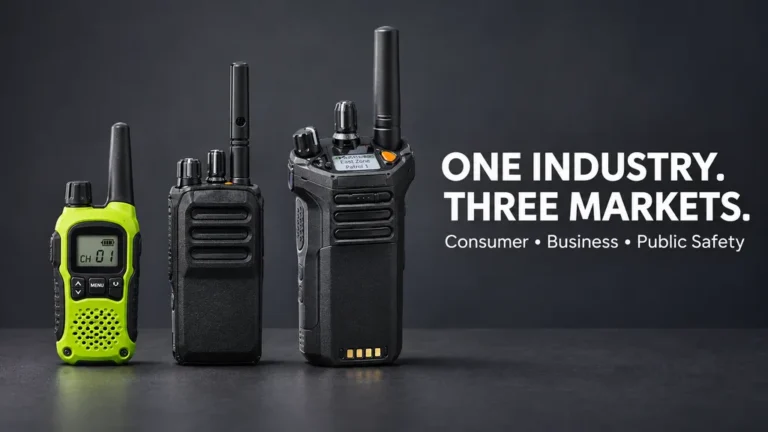
A radio’s brand, factory, importer, retailer, and repair provider can be different businesses with different responsibilities. The radio equipment industry value chain begins with components and design, moves through assembly and distribution, and continues through software, warranty service, and spare parts. A company name on a box or an FCC record identifies a particular role, not necessarily every company involved in making the device. Understanding these handoffs helps owners find reliable support without guessing who built the radio.
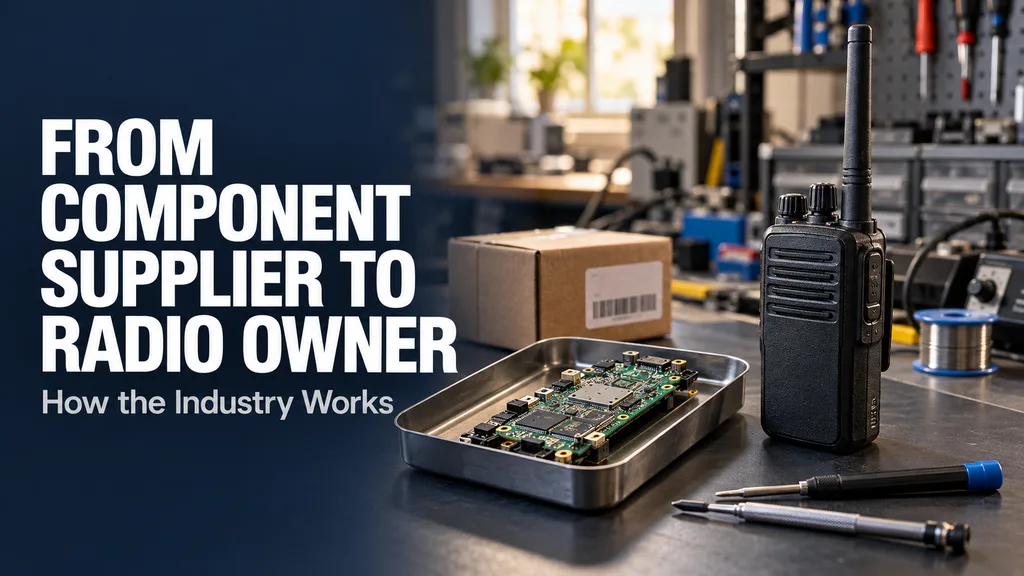
The name on the radio is only one part of the business
Suppose a handheld radio arrives with a familiar brand on its case, a different company listed on the shipping paperwork, and a third business handling the sale. If the battery stops charging, the seller may handle the return while the brand directs the owner to a separate repair provider. None of those details, by themselves, tells you who designed the circuit board or assembled the radio. They show that selling, supporting, and producing an electronic device are distinct jobs.
The useful question is not simply who makes radios, but what each participant contributes as the product reaches its owner. A component supplier provides parts, a design team defines how the device should work, and an assembly operation turns the design into finished units. Other organizations may manage regulatory obligations, imports, inventory, sales, software, and repairs. Some companies perform several jobs themselves, while others hire partners, so the sequence is a way to understand responsibilities rather than a map of any particular brand’s suppliers.
Design, components, and assembly are separate economic roles
Radio production starts well before a finished unit receives a brand name. Component producers supply items such as semiconductors, displays, connectors, batteries, and other materials used in electronic equipment. A product design team then makes choices about the intended radio service, user controls, electrical architecture, software behavior, and physical construction. The team integrating those parts must also account for compatibility, production tolerances, and the requirements that apply to the finished product.
An assembly operation converts the approved design and parts into manufactured units, but assembly does not automatically mean ownership of the design or trademark. The business commissioning a product may supply its own specifications and retain product decisions even when an outside company builds it. Conversely, a supplier may offer substantial design work as part of its commercial arrangement. Owners usually cannot determine the exact split from the appearance of the housing, because similar looking radios can have different components, firmware, and contractual arrangements.
- Component production: Supplies the parts used in the device, often without selling complete consumer radios.
- Product design and integration: Defines the finished radio’s functions, configuration, documentation requirements, and intended use.
- Assembly and production control: Builds units and checks that production follows the specified design and quality process.
- Brand and product management: Decides how the finished product is presented, sold, supported, and maintained.
These roles can overlap inside one company. Treating them separately is useful because a brand’s customer service promise is not evidence that the brand owns a chip fabrication plant or operates the assembly line.
Importers, certification grantees, and distributors do different work
Once a radio is designed and produced, several businesses may be involved before it can reach a U.S. buyer. An importer handles a commercial role in bringing goods into the country, while a distributor typically purchases or manages inventory for resale through other businesses. A brand may use one of these channels, manage them directly, or combine the functions through a related company. The distributor’s name on an invoice therefore says more about the sales route than about the location of final assembly.
Regulatory responsibility is another distinct layer. Under the applicable FCC equipment authorization rules, the grantee of a certification is responsible for compliance of equipment covered by that grant; the rules assign responsibility differently for equipment using the Supplier’s Declaration of Conformity procedure. That distinction matters, but a grant is not a list of every component supplier or a factory ownership certificate. A reader trying to establish which companies can actually be identified for one model needs a separate, evidence-based provenance investigation rather than assumptions drawn from its retail packaging.
Key distinction: Regulatory responsibility, physical manufacturing, ownership of the brand, and ownership of retail inventory are different questions. A public record answering one of them does not necessarily answer the others.
Retail channels change who sells the radio and who answers first
A radio may reach an owner through a specialist dealer, a general electronics store, a brand-operated storefront, or an online marketplace. In a traditional dealer arrangement, the distributor or manufacturer may supply the dealer, which then sells the product to the customer. In a marketplace sale, the website hosting the listing is not necessarily the business that owns the inventory or fulfills the order. As a result, the store name, seller name, and brand name can all be different without those differences proving anything improper.
For the buyer, those distinctions become important when the order is wrong, an accessory is missing, or a device fails. The seller may control the return window, while the brand or its appointed provider controls warranty eligibility and technical repairs. An authorized dealer may be able to obtain parts or escalate an issue through a support channel that an unrelated marketplace seller cannot use. Before purchase, it is more useful to identify the seller of record and the applicable support terms than to assume every listing bearing the same logo has the same after-sale service.
The same business can also switch roles between transactions. A company might distribute one radio line, sell another line directly, and provide paid service for equipment it never manufactured. Looking at the actual transaction keeps these commercial functions understandable without turning an ordinary purchase into an unsupported claim about the factory.
A practical way to separate known roles from missing evidence
Public documents usually describe one slice of the chain rather than its entire history. A company website may explain its support operation, a seller listing may identify who takes payment, and a regulatory record may identify the party tied to a particular authorization. Each can be useful within its own limits. The trouble starts when a clear statement about one role gets treated as proof about a different one.
The table below is a general reading guide, not a verified supply chain for one radio. It distinguishes the business job from the kind of public evidence that might establish it. If a document does not name the assembly contractor, the appropriate answer is that the assembly contractor has not been established from that document. Filling the blank with a plausible company would make the explanation less accurate.
| Business role | What the role does | What public evidence may establish | What remains unknown |
|---|---|---|---|
| Component supplier | Provides electronic parts and materials | A supplier’s own published product or business description | Whether its parts appear inside a particular radio |
| Design organization | Defines or integrates the product design | An attributable company statement about design work | The full design ownership or subcontracting terms |
| Assembly provider | Builds finished units to a specification | An explicit, product-specific manufacturing statement | Factory identity when no reliable disclosure exists |
| Certification grantee | Holds the relevant certification and associated compliance responsibility | The applicable authorization record and FCC rules | Who fabricated parts or assembled the unit |
| Importer or distributor | Moves products into a market or through wholesale channels | Attributable import, distribution, or channel documentation | Who designed or manufactured the device |
| Retail seller | Offers the product and handles the purchase transaction | Seller information, invoice, and published return terms | Any undisclosed upstream manufacturing contracts |
| Support provider | Supplies manuals, service, repairs, or replacement parts | Published support and repair instructions | Whether the provider owns the original design |
Read the final column as a guardrail. A useful industry overview can explain what a role normally involves without pretending that the whole chain has been disclosed for every product.
Software and documentation keep the chain active after the sale
Manufacturing a radio is only one part of delivering a usable product. Operating instructions, programming utilities, firmware, drivers, and troubleshooting information may be created or maintained by different teams. A hardware vendor can document its equipment while an independent developer maintains software used with that hardware. This arrangement is especially visible in software-defined radio, where receiver hardware, drivers, and listening applications do not always come from the same organization.
Icom America, for example, publicly maintains support areas for manuals, firmware, and technical assistance alongside its radio product categories. That is evidence of its published support role, not proof that every underlying component or software dependency is produced within one corporate organization. For an owner, the practical concern is whether the exact radio and its hardware or regional variant have reliable instructions and appropriate updates. A generic download bearing a familiar name should not be assumed compatible with every unit that looks similar.
Software also introduces responsibilities that extend beyond the original sale. An organization may maintain documentation or release fixes, while an independent application may change without the device maker controlling it. Owners comparing accessories or connections can use the radio compatibility guide to frame the exact model, connector, software, and intended use questions rather than assuming a common logo guarantees interoperability.
Warranty service and spare parts have their own economics
After-sales support requires people, replacement parts, records, repair facilities, and a process for deciding which failures qualify for warranty coverage. Those costs do not disappear after a production run ends. A brand or service provider has to decide which products it can still diagnose, which parts can be sourced, and which repairs are economical. A radio remaining functional in an owner’s hands does not guarantee that every replacement component will remain available indefinitely.
Icom America’s repair information provides a concrete example of a published service arrangement: its repair centers handle many products, and authorized outside facilities perform certain warranty repairs. The same repair information cautions that some older equipment may not be repairable because of age or parts availability. These statements identify service channels and support limits; they do not disclose the original contract assembly arrangements for the equipment. The lesson for an owner is to verify the actual support route before assuming a logo guarantees a particular repair outcome.
Different failures also belong at different points in the chain. A delivery error normally starts with the seller, while a documented hardware fault may go to the warranty provider and a setup issue may be resolved with the brand’s published instructions. For practical troubleshooting rather than industry structure, see the radio accessories, power, and troubleshooting guide. Routine handling and storage decisions belong in the radio care and storage guide, not in a search for a hidden manufacturer.
Contract manufacturing is a possible arrangement, not a fact to assume
Consumer electronics businesses often have a choice between operating production facilities and buying manufacturing services from another company. A contractor may only assemble a design supplied by its customer, or a commercial relationship may include design and engineering services as well. Industry terms such as OEM and ODM describe different possible relationships, but their everyday use is inconsistent enough that labels alone are not a substitute for a contract or a reliable company disclosure. Even when a supplier publicly says it offers contract manufacturing, that does not establish that it produced a particular radio.
Cost, production capacity, component access, and the ability to scale a product line can influence the decision to outsource. Contract work may help a brand avoid operating every process internally, while creating dependencies on specifications, parts availability, quality oversight, and communication between businesses. Those are ordinary tradeoffs in electronics production, not evidence of low quality or hidden misconduct. A branded radio can be well supported or poorly supported under either an in-house or outsourced manufacturing arrangement.
Contract terms can also determine who approves design changes, pays for tooling, manages component substitutions, and handles production defects. These decisions influence the ability to keep a model available or address problems after launch. Buyers rarely see the underlying agreements, so published warranty terms, parts policies, and official support contacts are more useful measures of continuing responsibility than an OEM or ODM label.
The RTL-SDR ecosystem shows why one label cannot describe every role
The history described on RTL-SDR Blog’s own About page offers a useful illustration of separate contributions. It credits independent contributors and the Osmocom community with enabling certain television tuner hardware to work as inexpensive software-defined radio receivers. It also describes community created software, hardware sellers, and RTL-SDR Blog’s own improved receiver hardware. These are publicly described roles in an ecosystem, not a documented end-to-end supplier list for any one device.
This example is especially revealing because the broader RTL-SDR technique and community software are not identical to the RTL-SDR Blog seller or its branded hardware. A developer can contribute a driver without assembling the receiver, and a hardware seller can market an improved version without owning the entire software ecosystem. A buyer who encounters a device advertised as an RTL-SDR therefore needs to distinguish the technology, the particular seller, and the software needed for operation. That distinction also helps direct a software question toward developer documentation and a defective retail unit toward the appropriate seller or support provider.
The company’s separate authenticity guidance adds a retail channel lesson: it publishes information about official selling accounts and resellers and warns buyers about imitations. That is an attributable statement of how the business presents its sales channels, not independent proof of every claim about competing products. It illustrates why the seller of record matters when a product name is shared across a broad technical category. For an owner, those published channel details can help identify where to ask about an order or a suspected imitation.
What the value chain cannot reveal about an actual factory
The sequence from parts to support describes work that must be performed, but it does not name the organizations performing every task. A manufacturer may use several component sources or assembly partners, change suppliers, or keep commercial terms confidential. A company can also use the word manufacturer in a broad business sense that does not specify who owns or operates the final assembly plant. Neither a familiar enclosure nor a close match between product specifications is enough to settle those questions.
Public sources should be read for the claims they actually make. A published repair center establishes a service path, a dealer page establishes a channel relationship, and a certification record identifies a regulatory role under the applicable procedure. None is automatically a bill of materials, production contract, or statement of factory ownership. When the exact factory is not disclosed by reliable evidence, the responsible conclusion is that it has not been established.
This boundary matters because confusing the roles can lead to bad decisions. A buyer might contact a component maker for a warranty claim it cannot handle, or dismiss a brand’s support merely because its products may be contract assembled. Instead, follow the responsibility relevant to the problem: seller for the transaction, official documentation for operation, authorized support for service, and regulatory records only for what those records establish.
Final thoughts: map the roles before assigning names
The most useful way to understand the radio industry is to separate the jobs that create, move, sell, and support a device. Component production, design, assembly, regulatory responsibility, importing, distribution, retail, software, and repair may sit within one organization or span several. A clear understanding of those jobs explains why different names can appear on the same product’s paperwork. It also clarifies why software updates, spare parts, and dealer assistance may change independently during the life of a radio.
For an owner, begin with the question that affects the next action. If you need a return, identify the seller; if you need documentation, find the official support channel; if a radio has failed, check the warranty and repair process. When considering an older model, check whether compatible software, replacement parts, and a workable service route are still available. Those practical details often matter more to long-term ownership than a company’s position in the production chain.
Frequently asked questions
Does the brand on a radio tell me who manufactured it?
Not necessarily. The brand identifies how a product is marketed, but the brand owner may perform production itself or use outside suppliers. Establishing a specific factory requires credible product-specific evidence.
Is the FCC grantee always the assembly factory?
No. For certified equipment, the grantee has a defined regulatory responsibility, but the grant does not by itself identify every business involved in design or assembly. Do not read factory ownership into a compliance record.
What is the difference between an importer and a distributor?
An importer is involved in bringing products into the country, while a distributor commonly supplies inventory to resellers or other sales channels. One company may perform both roles. Neither title alone proves who designed the device.
Does contract manufacturing mean a radio is lower quality?
No. Outsourcing assembly describes a business arrangement, not a measured quality level. Product specifications, quality controls, documentation, and actual support matter more than guessing whether the factory was owned by the brand.
Who should I contact if a radio stops working?
Start with the seller’s return terms if the issue is part of a recent transaction, then check the brand’s official warranty and repair instructions. A repair provider may be different from the shop that sold the device. Follow the published support procedure for the exact model.
Why can a radio still work after official repairs are discontinued?
A functioning device does not depend on an active repair program every day. Repair support, however, requires technicians, procedures, and available parts that may no longer be economical to maintain. Check the current support information rather than assuming parts availability from the radio’s continued operation.
References and sources
- Electronic Code of Federal Regulations, 47 CFR 2.909: Regulatory responsibility under equipment authorization procedures.
- RTL-SDR Blog, About RTL-SDR: The organization’s account of developer, community, software, and hardware seller roles.
- RTL-SDR Blog, Genuine: The company’s stated official sales channels and authenticity guidance.
- Icom America, Support: The company’s published manuals, software, firmware, and technical support channels.
- Icom America, Repair: Published repair arrangements, authorized service locations, and parts availability limitations.