The two-way radio industry is not a single group of shoppers buying similar handheld devices. Household buyers, organizations managing radio fleets, and public-safety agencies purchase different combinations of equipment and support. Industry reports can therefore describe different markets even when their titles sound almost identical. The useful comparison starts with who pays, what the transaction includes, and which customers the report actually counts.
Which transactions count as two-way radio equipment sales?
A toy walkie-talkie, a handheld carried by a construction worker, and a radio used within a public-safety network all allow people to communicate. That shared function does not make their purchases interchangeable in a market report. A household may buy a packaged pair of radios at retail, while an organization may purchase individual handsets, chargers, replacement units, and ongoing support through a dealer. A larger system may also involve infrastructure and services that never appear on a consumer store shelf.
For a useful industry classification, start with the transaction rather than the shape of the device. Identify the paying customer, the equipment or service being purchased, the distribution channel, and whether the amount represents a one-time hardware sale or continuing revenue. Then check whether the research publisher counts that combination in its stated market. A report about professional equipment cannot automatically be used as a measure of household radio demand merely because both contain portable radios.
- Handset or kit: A portable or mobile radio sold individually or as a retail package.
- Fleet purchase: Multiple radios and associated equipment purchased for a workplace or institution.
- Network equipment: Supporting components, such as base stations or repeaters, when the report explicitly includes them.
- Ongoing service: Maintenance, subscriptions, or software that must be checked separately rather than assumed to be hardware revenue.
These categories describe possible transactions, not guaranteed inclusions in every research study. One purchase can contain several components, so an invoice total and a hardware-only revenue figure are not necessarily comparable. That distinction becomes especially important when reports mix devices with network elements or discuss connected communications platforms. Read the publisher’s definition before interpreting its totals or segment labels.
Household and recreational buyers form a different retail population
For a household, two-way communication may be an occasional convenience rather than an operating requirement. Family outings, recreation, and casual group activities create demand for straightforward equipment with manageable setup and cost. The buyer commonly compares a small number of devices and may never purchase fleet management, a dispatch console, or a support contract. The relevant transaction is usually the retail product, not a commissioned communication system.
Even this category needs careful boundaries. A toy intended mainly for play is not necessarily counted alongside a consumer radio sold for actual communication, and the decision belongs to each publisher’s market definition. A product sold through an online store is not automatically a household purchase either, because organizations also buy online. The safest description is a consumer or recreational buyer segment defined by end use, with retail distribution treated as a separate dimension.
Dataintelo’s published two-way radios and PMRs report explicitly lists personal use as an application category. That confirms the publisher has a named place for at least some nonorganizational demand, but the public category label alone does not tell us precisely which children’s products or recreational radio types qualify. By contrast, Mordor Intelligence describes a scope centered on commercial, industrial, and government customers, and expressly excludes consumer toy walkie-talkies. Neither statement justifies treating all household purchases as included in both reports.
Small teams and organizational fleets are not all the same buyer
A small shop coordinating employees may buy a few basic radios, while a construction company with several crews may need consistent equipment across many users and locations. Both purchases serve a business, but the buying process and the costs surrounding the radios can be very different. One organization may purchase from ordinary retail channels, while another uses a specialized dealer to source compatible equipment and support. This is why the word commercial can conceal a wide range of transactions.
Motorola Solutions’ professional mobile radio white paper describes a progression from simple commercial communication to business-critical professional needs and then mission-critical systems. Its categories are a vendor explanation of organizational requirements, not a government-issued market classification. Importantly, its low-cost commercial group is still made up of organizations; it is not a substitute for a household recreation segment. The document also discusses reliability, geographic coverage, and integration as reasons professional customers can have a more involved buying process.
For reporting purposes, the practical questions are whether the organization buys radios individually or as a fleet, whether supporting equipment is involved, and whether a vendor or reseller provides continuing services. A hospitality property and an industrial operator might both appear in a broad business radio report, yet their transaction mix can differ. The exact mix should never be inferred simply from their industry name. A buyer-segment taxonomy explains the customer; it does not predict what equipment that customer should operate.
Public-safety and mission-critical systems have a different cost structure
Government agencies and public-safety organizations can purchase communications capabilities rather than just a collection of handheld radios. A procurement may involve devices, network elements, integration, maintenance, and other support arrangements, depending on the system and contract. These needs help explain why public-safety customers appear as a distinct category in many industry reports. They do not mean that every agency contract includes the same equipment or that every line item belongs in a two-way radio market estimate.
The Motorola Solutions white paper places mission-critical organizational communication at the demanding end of its professional market discussion. Mordor Intelligence separately identifies government and public safety as an end-user industry in its published segmentation. Dataintelo also lists public safety as an application category, although that label is not necessarily constructed using the same accounting rules. Those descriptions establish the existence of distinct buyer groups, not a universal standard for valuing their purchases.
Device revenue versus infrastructure, software, and maintenance
Consider a hypothetical agency contract containing portable radios, fixed network equipment, and continuing maintenance. A hardware-oriented estimate might count the radios and designated network elements but exclude an unrelated software license or later service work. A broader communications contract figure might include much more of the total project. Adding the two figures together could count the same equipment twice if the boundaries overlap.
Mordor Intelligence expressly includes devices and supporting radio network elements sold to end customers in its published definition. That is more specific than simply saying it covers professional radio systems, but it still does not authorize treating every related service contract as equipment revenue. Dataintelo’s public summary identifies applications and distribution channels without resolving every infrastructure or maintenance boundary at the same level of detail. Where a report does not disclose an inclusion clearly, the accurate classification is not established from the public description.
This section describes how to read market reports, not how emergency communications should be designed or purchased. Procurement, operational reliability, and safety requirements are specialized decisions made under the relevant agency’s rules and technical responsibilities. They are not conclusions a consumer can draw from a segment chart. The useful lesson here is to keep the cost basis separate from the customer label.
Analog and digital technology do not define the buyer segment
Market reports often divide products into analog and digital categories, but technology and customer type answer different questions. A digital radio can be purchased for an organization, and an analog radio can serve either a casual buyer or a workplace. Knowing the signaling technology does not identify who paid for the unit or whether the sale included a larger system. A chart showing digital adoption therefore cannot be read as a chart of professional buyers without additional evidence.
The distinction also applies to standards and product form factors. A handheld may be part of a specialized fleet, while a mobile or fixed component may be purchased for another use entirely. Industry studies can classify the same underlying sale by technology, device type, application, and end-user industry without creating four separate sales. Those are alternative views of a transaction, not amounts that should be added together.
Mordor Intelligence publicly organizes its study by device type, frequency band, standard, and end-user industry. Dataintelo publishes product-type categories alongside application, distribution-channel, and end-user categories. Both structures demonstrate that a market can be described along several axes at once. The analyst’s category names tell us what is being sorted, not whether any particular customer should use that technology.
A buyer-segment matrix makes the market boundaries visible
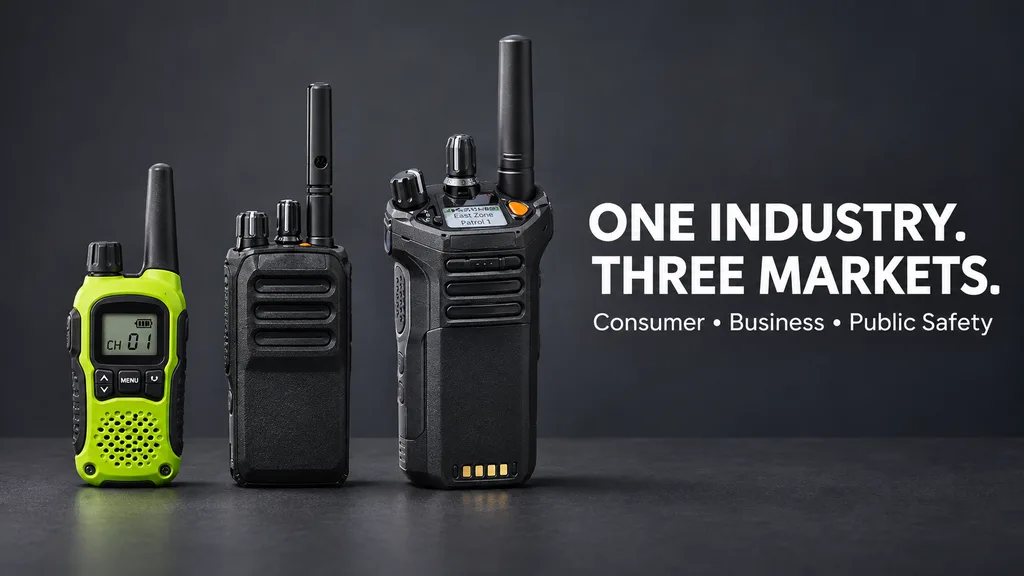
The simplest working model separates household and recreational demand, organizational fleet demand, and government or mission-critical demand. This is an editorial sorting tool for interpreting reports, not an official set of FCC categories. It focuses on who purchases communication capability and which transactions might accompany that purchase. Actual organizations and products can sit near the boundaries, so the matrix should be used as a first classification rather than a rigid industry rule.
| Buyer population | Typical transaction unit | Possible sales channel | Inference to avoid |
|---|---|---|---|
| Household and recreational | Individual radio or packaged retail set | General retail or online seller | Assuming every retail set or toy is included in a professional market report |
| Small business and organizational fleet | Single units, multiple handsets, accessories, or a managed fleet purchase | Retail, specialist dealer, or organizational supplier | Assuming every business sale has network infrastructure or a service contract |
| Government and mission-critical organization | Devices and, where specified, supporting system components or contracted services | Institutional procurement or specialist provider | Equating the value of an entire contract with radio hardware revenue |
The critical distinction is the purchasing arrangement, not whether the radio has an antenna, a push-to-talk button, or a digital label. A small business purchasing a boxed pair may have a transaction that resembles household retail even though the buyer belongs to an organization. Conversely, a contract covering multiple connected components may contain more than a device sale. When a real case crosses categories, record the buyer and the revenue items separately instead of forcing the whole transaction into a single product bucket.
What the two published research classifications include and leave unclear
Two reports with similar titles can start from different definitions of the market. Mordor Intelligence describes its two-way radio communication market around commercial, industrial, and government end customers, including devices and supporting radio network elements. Dataintelo’s two-way radios and PMRs study visibly includes personal use, commercial, and public-safety application segments. These are the publishers’ own report categories, and neither set is a universal regulatory or industry-wide classification.
There is also an important difference between a declared exclusion and a missing category. Mordor explicitly excludes consumer toy walkie-talkies, but its public end-user list not naming households is not proof that every consumer-oriented radio product is excluded. Dataintelo lists personal use but does not resolve every toy, infrastructure, and recurring-service inclusion in the public summary. A careful reader should preserve those uncertainties rather than inventing a neat agreement between the two reports.
| Scope question | Mordor Intelligence public definition | Dataintelo public description |
|---|---|---|
| Commercial and industrial buyers | Explicitly within the stated customer scope | Commercial application and several industry end-user categories are listed |
| Government and public safety | Explicit end-user category | Explicit public-safety application category |
| Personal or recreational use | No dedicated personal-use end-user category is shown | Personal use is explicitly listed as an application |
| Consumer toy walkie-talkies | Explicitly excluded | Not clearly resolved by the public category list |
| Handheld radio devices | Explicit handheld and portable device category | Radio products are covered, but handheld-only accounting is not established by the displayed category labels |
| Base stations and repeaters | Explicitly listed among device types and supporting radio network elements | Specific revenue inclusion is not clear from the public summary |
| Software and maintenance charges | Not established as generally included by its equipment definition | Specific revenue inclusion is not clear from the public summary |
| Cellular push-to-talk offerings | PoC is listed; ordinary cellular voice and messaging apps have stated exclusions | Discussed as adjacent or competitive offerings; exact inclusion needs clarification |
The matrix is intentionally conservative. It reports what can be established from the published descriptions rather than assuming access to every definition inside the full proprietary studies. Notice that the presence of a category does not answer every question about what revenue is counted within it. For a meaningful comparison, a buyer would need the providers’ detailed scope notes when public descriptions leave a line item unresolved.
Use an inclusion ledger before comparing report totals
An inclusion ledger is a short record of which transactions belong to a report and which remain uncertain. It prevents a familiar error: treating every product associated with radio communication as though every publisher counts its revenue. The ledger can be created without estimating market size or claiming knowledge of confidential contracts. It only needs a consistent set of questions applied to each source.
For each study, record the buyer population, covered product types, supporting infrastructure, software or maintenance treatment, geographic scope, and distribution channels. Mark each item included, excluded, or not established based on the report’s actual wording. Do not replace an unknown with a guess drawn from the vendor’s broader product portfolio. This keeps a market definition separate from assumptions about how a particular system is sold.
- Customer: Household, business, institution, government, or a specifically defined mix.
- Unit of sale: Individual device, retail package, fleet equipment, network element, or service.
- Included revenue: Hardware only, additional defined components, or an explicitly broader contract value.
- Geography: U.S., North America, global, or another region with the same boundary in both comparisons.
- Overlaps: Any component that could be counted both within a system bundle and as a separate equipment sale.
Imagine comparing a global study that includes professional repeaters with a separate analysis of household handheld sales. Their totals differ not only because their customers differ, but because their units of sale differ. Adding a fleet contract value to an equipment supplier’s revenue can introduce another overlap if the contract already contains those devices. Before comparing or combining figures, isolate matching customer populations and revenue components, then confirm that each transaction is represented only once.
Where to go when the question is which radio to use
Industry segmentation is helpful for understanding demand, but it cannot decide which radio service or device fits a person’s situation. The same buyer group can contain several communication needs, and the same sales channel can carry equipment intended for different operating rules. A consumer shopping for family communication needs service and equipment guidance, not a market analyst’s category label. Moving straight from a report segment to a purchase recommendation skips the most important decision.
For that separate task, start with the guide to choosing a radio system. Readers coordinating a small crew can use the walkie-talkie guide for small teams to frame their practical needs, then consult the business radio rules guide when workplace operating requirements are relevant. Those guides address choices for users rather than the accounting boundaries of industry reports. They are the better starting point when an actual purchase or operating decision is at stake.
A market’s use of the labels personal, commercial, or professional does not establish what is permitted to transmit in the United States. Nor does an international report category make radios from different services interchangeable. The industry taxonomy should stay on its proper side of that boundary. Use it to understand who buys and what is sold, then make any equipment decision from the rules and compatibility of the actual radio service.
Final thoughts: a market segment is not a radio recommendation
The best way to understand the two-way radio industry is to sort customers before comparing products or reports. A household retail purchase, an organizational fleet order, and a public-safety system contract can contain different revenue components. Similar-looking radios do not make those transactions equivalent. Neither do similar report titles guarantee that their figures measure the same market.
When reviewing a study, check its stated customer categories, product inclusions, and exclusions first. If the public summary leaves infrastructure, software, or service revenue unclear, keep that item unresolved instead of filling the gap with an assumption. Compare figures only after the customer population and accounting boundary match. That one discipline makes industry reporting more useful without mistaking it for advice about which radio to buy or operate.
Frequently asked questions
📻 Are consumer walkie-talkies part of the two-way radio industry?
They can be, but inclusion depends on the report’s definition. Dataintelo lists personal use as an application, while Mordor explicitly excludes consumer toy walkie-talkies. Check whether a study measures household communication devices, toys, or mainly professional equipment before using its figures.
Why can two reports with similar names describe different markets?
They may count different customers, equipment categories, regions, or revenue components. A study covering repeaters and organizational buyers is not necessarily measuring the same sales as a retail handheld study. Compare their inclusion rules before comparing the numbers.
Does a business buying a few handheld radios count as a professional fleet?
It is an organizational purchase, but the report’s categories determine how it is recorded. Buying a small retail pack does not automatically imply a managed fleet or supporting network. Identify the purchaser and the actual transaction rather than inferring a complex system from the business label.
Are repeaters and dispatch systems always included in radio market estimates?
No. Mordor’s published definition includes supporting radio network elements, but other reports may draw a narrower boundary. Dispatch software, integration, and maintenance should be checked as separate revenue items unless the publisher explicitly says how they are treated.
Does digital radio revenue mean professional radio revenue?
No. Digital is a technology classification, while professional describes a customer or use context. A study can show both dimensions without making them equivalent. Look for a cross-tabulation or an explicit end-user definition if you need to relate them.
Can a global industry report tell me which radio service to choose in the U.S.?
No. A market report describes commercial activity under its own research definitions, not an individual’s operating permissions. Use guidance specific to the radio service, the equipment, and the intended use. Market categories are not substitutes for U.S. service rules.
References and sources
- Mordor Intelligence, two-way radio communication market: Published market definition, customer sectors, explicit exclusions, and treatment of supporting radio network elements.
- Dataintelo, two-way radios and PMRs market: Published application, product, distribution, and end-user category labels.
- Motorola Solutions, standards for professional mobile radio: Vendor explanation of commercial, business-critical, and mission-critical organizational needs.