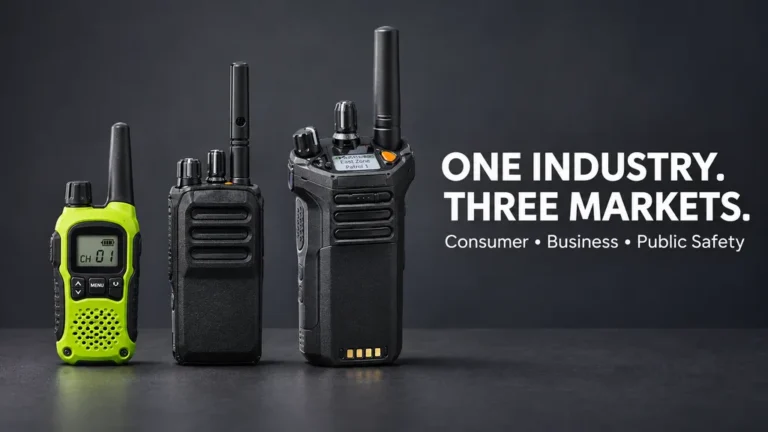
The U.S. consumer radio market is better understood as a collection of equipment categories than as one established industry total. It includes everyday two-way radios, weather-alert receivers, broadcast and shortwave radios, scanners and beginner listening receivers, amateur radio equipment, and recreational marine radios. These products serve different customers, follow different rules, and may be sold through overlapping channels. A global professional two-way radio estimate cannot establish the size of this entire U.S. consumer equipment market.
What consumer radio equipment means in this market
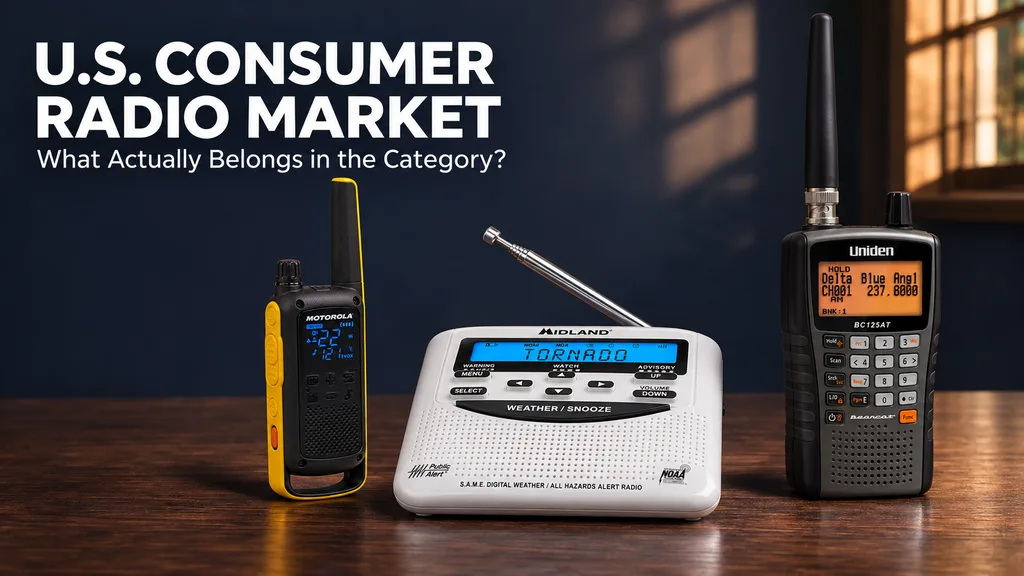
Picture a store displaying a family walkie-talkie, a tabletop weather radio, and a scanner. All three receive radio signals, but only the walkie-talkie is intended for the shopper to transmit ordinary voice messages. The weather receiver exists to deliver broadcasts and alerts, while the scanner is purchased to monitor transmissions its owner is permitted to receive. Grouping them under one retail label is useful for finding merchandise, not for proving that they share a measurable sales market.
For this site, consumer radio equipment means radio hardware a U.S. household, hobbyist, recreational user, or small group might select, own, and operate for everyday communication or listening. The boundary is based on the product’s job and the customer’s use, not on whether the device contains a radio chip. It does not imply that every device is license-free or suitable for every user. Six equipment families provide a practical map, with overlaps identified instead of counted twice.
Two-way and amateur transmitting equipment
Consumer two-way equipment includes familiar FRS handhelds alongside GMRS, CB, and MURS radios used in their respective services. Amateur radio equipment belongs in a separate family because its operating purpose and authorization framework differ from those personal radio services. A radio that can transmit is not interchangeable with another simply because both have a microphone or a push-to-talk button. The FCC’s service distinctions help establish these product categories, but they do not reveal how many units consumers buy.
Broadcast and NOAA receiving equipment
Portable AM/FM radios and shortwave receivers primarily serve people who want to listen, whether at home, while traveling, or as a hobby. NOAA Weather Radio receivers serve a more specific purpose by receiving National Weather Service broadcasts, and appropriately equipped units can respond to transmitted alert signals. NOAA produces the broadcasts but does not manufacture or sell the receivers, making the broadcasting service different from the consumer hardware business. A radio combining weather and AM/FM reception belongs to more than one feature category but remains a single physical unit.
Scanners, listening SDRs, and recreational marine radios
Radio scanners and beginner software-defined radio receivers form a listening-oriented category centered on tuning and monitoring supported signals. Software-defined radio, or SDR, describes an approach to radio hardware and processing rather than one universal consumer device type; this category concerns entry-level receiving equipment, not every SDR transmitter or professional platform. Recreational marine VHF radios are different again because boaters use appropriate equipment for vessel communications and safety-related calls. A scanner with weather reception, a marine radio with weather channels, and a dedicated NOAA alert radio should not automatically be treated as three separate weather-radio sales.
| Equipment family | Transmit or receive? | Typical U.S. buyer or use | Included examples | Important boundary |
|---|---|---|---|---|
| Personal and everyday two-way | Transmit and receive | Families, road travelers, and small groups | FRS, GMRS, CB, and MURS radios | Not professional dispatch networks or every business radio contract |
| Weather-alert receivers | Receive only | Households seeking weather information and alerts | Dedicated NOAA weather receivers and alert radios | NOAA’s broadcast network is not consumer receiver revenue |
| Broadcast and shortwave listening | Receive only | Everyday listeners and shortwave enthusiasts | Portable AM/FM and shortwave receivers | Excludes radio station advertising and program revenue |
| Scanners and beginner listening SDR | Receive only within this category | Monitoring and radio-listening hobbyists | Handheld scanners, desktop scanners, and USB SDR receivers | Excludes professional monitoring systems and transmitting SDR platforms |
| Amateur radio retail | Many radios transmit and receive; some products only receive | Licensed operators and radio enthusiasts | Amateur handheld, mobile, and station equipment | Not equivalent to FRS or GMRS, and not all amateur gear is a transceiver |
| Recreational marine radio | Transmit and receive | Recreational boat owners and operators | Handheld and fixed-mount marine VHF radios | Excludes commercial fleet communications systems |
The table describes equipment families, not mutually exclusive sales-reporting codes. A combination receiver may cross several rows, and a dealer may sell both consumer and institutional equipment. Classification must therefore happen at the product and transaction level before any revenue could be assigned. Otherwise, an apparent total could count one sale repeatedly or absorb unrelated spending.
Define the U.S. customer and product boundary before counting
“U.S. market” can mean equipment purchased by U.S. end users, equipment shipped into U.S. distribution, sales recognized by U.S. companies, or radios manufactured domestically. Those are different measurements even when they describe some of the same products. A U.S. brand can sell imported hardware, a domestic retailer can resell an overseas product, and a manufacturer can report revenue from countries outside the United States. A usable market definition starts by choosing one geographical and transaction boundary, then applies it consistently.
The word “consumer” also requires a decision about the buyer. An individual buying a handheld radio for recreation is an obvious consumer transaction, but a small business might purchase the same model for routine coordination. The equipment can remain consumer-facing while the buyer belongs to a business, which means product scope and customer scope are separate questions. For this guide, the six families describe the product-side niche; they are not a claim that every purchase in those families comes from a household.
A careful classification should record at least the product’s main function, applicable radio service when transmission is involved, buyer type, sales channel, and whether the transaction is new hardware or something else. Accessories can be relevant to ownership without being added to radio-unit counts, and used equipment needs separate treatment from new retail sales. These distinctions prevent a broad product catalog from becoming a misleading market denominator. They also explain why a shelf of radios is evidence that categories exist, not evidence of national demand.
Which institutional systems and cellular products are excluded
Public safety dispatch systems, government communications projects, utility networks, and large commercial land mobile radio deployments are outside this consumer equipment boundary. Their purchases may include infrastructure, repeaters, consoles, integration, maintenance, and contracts that are not comparable to a household buying a portable radio. Federal and nonfederal spectrum users also have different regulatory oversight, as the NTIA explains, but regulatory jurisdiction is not itself a consumer market category. Including the price of an agency-wide communications upgrade would change what the market means.
Cellular infrastructure, carrier subscriptions, smartphones, and ordinary wireless accessories are excluded even though they all depend on radio technology. A phone app offering push-to-talk may perform a similar task to a conventional handheld, but it does not make cellular service revenue part of this equipment inventory. Commercial broadcasting is excluded on the same principle: the money a station earns from advertising or programming is not the value of the receiver a listener purchases. The same exclusion applies to general Wi-Fi networking gear, aviation infrastructure, and specialized industrial RF systems.
These are scope decisions, not claims that adjacent industries lack importance. In fact, their scale can dominate a broad report and obscure the products a consumer radio reader actually recognizes. A report may reasonably include them if it clearly declares its own broader scope. The error occurs when its headline is reused as though it described only the six families above.
Why each category has a different route to ownership
Radio purchases begin with different needs, and those needs affect where a product is sold and what the buyer is paying for. A household might want an alerting receiver that stays in one room, while a traveling group needs radios that can communicate with one another under the appropriate service rules. An amateur operator may buy equipment through a specialist dealer, and a boater may shop through marine supply channels. None of those paths is captured reliably by counting a single retailer’s radio shelf.
Some products are bought as standalone devices, while others require supporting equipment or depend on features already built into a different radio. A combined receiver can replace the need for a separate weather unit, but that substitution should not be interpreted as a fall in demand without actual transaction evidence. Specialist dealers, general electronics retailers, marine retailers, and online marketplaces can also carry overlapping inventory. The sales channel describes how the customer acquires equipment, not necessarily which family the equipment belongs to.
- Product function: communication, weather alerts, broadcast listening, scanning, amateur operation, or marine use.
- Buyer context: personal, household, hobby, recreational, small-business, or institutional.
- Transaction type: new hardware, used hardware, accessory, subscription, or service contract.
- Sales route: general retail, specialist dealer, marine supplier, direct manufacturer sale, or another channel.
This separation helps explain market structure without turning the article into a supply-chain study. It also keeps equipment eligibility, licensing, and safe operation separate from sales classification. If the practical question is which radio system a person should use, the answer belongs in an operating or buying guide rather than in this market map.
Why a global professional two-way total cannot represent this consumer niche
Consider a published global two-way radio market report that covers government, public safety, industry, and commercial users. Its definition may include handhelds along with mobile radios, base stations, repeaters, and network elements. Those items can be legitimate parts of the report’s market, but they do not represent the same purchasing universe as consumer weather receivers, broadcast radios, or scanners. Even its handheld portion cannot be assumed to consist of U.S. family walkie-talkies.
The geographical mismatch is just as important as the product mismatch. A global total is not a U.S. total, and a North American share is not automatically a U.S. consumer share. The Mordor Intelligence two-way report, for example, explicitly defines a broad communications equipment scope involving commercial, industrial, and government users; it is useful here as a demonstration of why labels must be read carefully. Its figures are not evidence for a combined U.S. consumer radio hardware total, and no amount from that report is adopted as such.
There is also an overlap problem when researchers try to add several reports together. A marine VHF radio might appear in a wider two-way category, while an amateur product could be represented in a specialist electronics category. Some multi-band receivers cover both broadcast and weather services, and a vendor’s revenue may mix hardware with support. Adding published totals without resolving these differences would produce a number that looks precise but does not have a consistent denominator.
What data a defensible U.S. total would require
A defensible U.S. consumer radio equipment total would need data for each family using compatible geography, time coverage, sales definitions, and channel treatment. It would need to separate new equipment from used resale, hardware from software and services, and consumer transactions from institutional contracts. It would also need a rule for allocating combination devices only once and excluding unrelated radio-enabled electronics. Without those inputs, there is no verified single U.S. total to report for this six-family definition.
Existing sources can establish that a product category exists without answering how much that category sells. NOAA documents what weather receivers are for and where people can obtain them, but it does not report comprehensive national receiver revenue. The Smithsonian documents a consumer broadcast receiver as a historical product, while manufacturer catalogs show that amateur radios and scanners are offered commercially. None of those facts supplies a reconciled national sales denominator.
| Evidence source | What it establishes | What it does not establish |
|---|---|---|
| FCC service definitions | Distinct personal and amateur radio operating categories | Consumer spending or shipment totals |
| NOAA and National Weather Service receiver guidance | Weather receiver purpose and availability through retail channels | Aggregate U.S. weather receiver sales |
| Smithsonian broadcast receiver collection | Existence and history of consumer radio receivers | Present-day sales volume or market share |
| Manufacturer amateur catalogs | Examples of amateur equipment product lines | Industry-wide sales across competing brands |
| Manufacturer scanner documentation | Examples of dedicated scanning receiver products | Independent market sizing for scanners or SDR |
| U.S. Coast Guard marine radio information | Recreational marine radio use and equipment context | U.S. consumer marine equipment revenue |
| Global two-way industry reports | The scope of a publisher’s broader communications estimate | A combined U.S. consumer radio total |
The missing ingredient is not another generic market headline; it is a matched set of transaction data with disclosed category rules. Such data would have to identify actual U.S. end-market purchases, remove duplicated channels, and explain treatment of integrated products. Until comparable evidence exists, the six-family classification is useful as a boundary map, not a revenue calculation. Leaving the number unknown is more accurate than filling the gap with an unrelated forecast.
Final thoughts: a trustworthy market map starts with exclusions
Before accepting a headline about the radio market, ask which devices, buyers, transactions, and countries it actually counts. A personal two-way handheld, a weather-alert receiver, and a scanner can all be consumer equipment without belonging to one established reporting category. The useful common ground is a clearly defined set of products, not a presumed common revenue total. Keeping institutional networks, broadcasting businesses, and cellular services outside the boundary makes the description more meaningful.
For the U.S. consumer equipment niche, the practical starting point is the six families above and the overlaps between them. Use official service information to confirm a category, retail catalogs to illustrate available products, and comparable transaction data only when making a sales claim. If a source cannot identify what it counts, its market number should not be promoted as a fact about the whole niche. The honest conclusion is a well-defined market map with no fabricated total attached.
Frequently asked questions
Does the consumer radio market include ham radio equipment?
Yes, amateur radio equipment is one of the six product families in this definition. It remains distinct from FRS, GMRS, and other personal radio services because the operating rules and buyer needs differ. Its inclusion here does not mean every consumer can transmit on amateur frequencies.
Are NOAA weather radios part of the two-way radio market?
Dedicated NOAA weather receivers are receive-only equipment, so they do not belong in a narrowly defined market for two-way transmitting devices. They do belong in a broader consumer radio equipment inventory. Combination devices require careful classification to avoid counting the same sale twice.
Do radio scanners and SDR receivers count as consumer radios?
Yes, scanners and beginner receiving SDR devices fit the consumer listening category used here. The term SDR can also describe more capable transmitting or professional systems, which are not automatically included. A product’s actual function matters more than the abbreviation on its label.
Can a global two-way radio market figure tell us U.S. consumer radio sales?
No. The report could include government and industrial systems, network equipment, and sales outside the United States while excluding most receive-only devices. A compatible U.S. consumer total would require separate, consistently defined transaction data.
Does a small business purchase make a radio professional equipment?
Not automatically. A small team may purchase an everyday radio model that is also sold to households, while a large organization may buy specialized integrated systems. Product category and purchaser type should be recorded separately if the goal is to measure sales.
References and sources
- 47 CFR 95.503, Family Radio Service definitions: Definition of FRS as an everyday two-way communications service.
- 47 CFR 95.1703, General Mobile Radio Service definitions, 47 CFR 95.2703, MURS definitions, and 47 CFR 95.903, CB Radio Service definitions: Distinctions among personal radio services.
- 47 CFR 97.3, amateur radio definitions: The distinct purpose and authorization framework of the amateur radio service.
- NOAA, Weather Radio All Hazards and National Weather Service, receiver information: Receive-only weather broadcasts and retail receiver scope.
- Smithsonian National Museum of American History, Regency transistor radio: Historical evidence for consumer broadcast receivers.
- Icom America, amateur radio product categories and Uniden, scanner product documentation: Manufacturer examples of equipment families, not independent sales data.
- U.S. Coast Guard Navigation Center, radio information for boaters: Recreational marine radio context.
- NTIA, who regulates the spectrum: U.S. government and nonfederal spectrum oversight distinction.
- Mordor Intelligence, global two-way radio market report: Illustrates the different scope of a global commercial and institutional report; not used as a U.S. consumer market estimate.